
Your Support in Action
Fall 2025
In our 25th anniversary year, NTSUSA donors have made significant contributions to protecting Scotland’s heritage and natural beauty at National Trust for Scotland properties. We’re pleased to share a report from Scotland on just some of the work that you made possible this year.
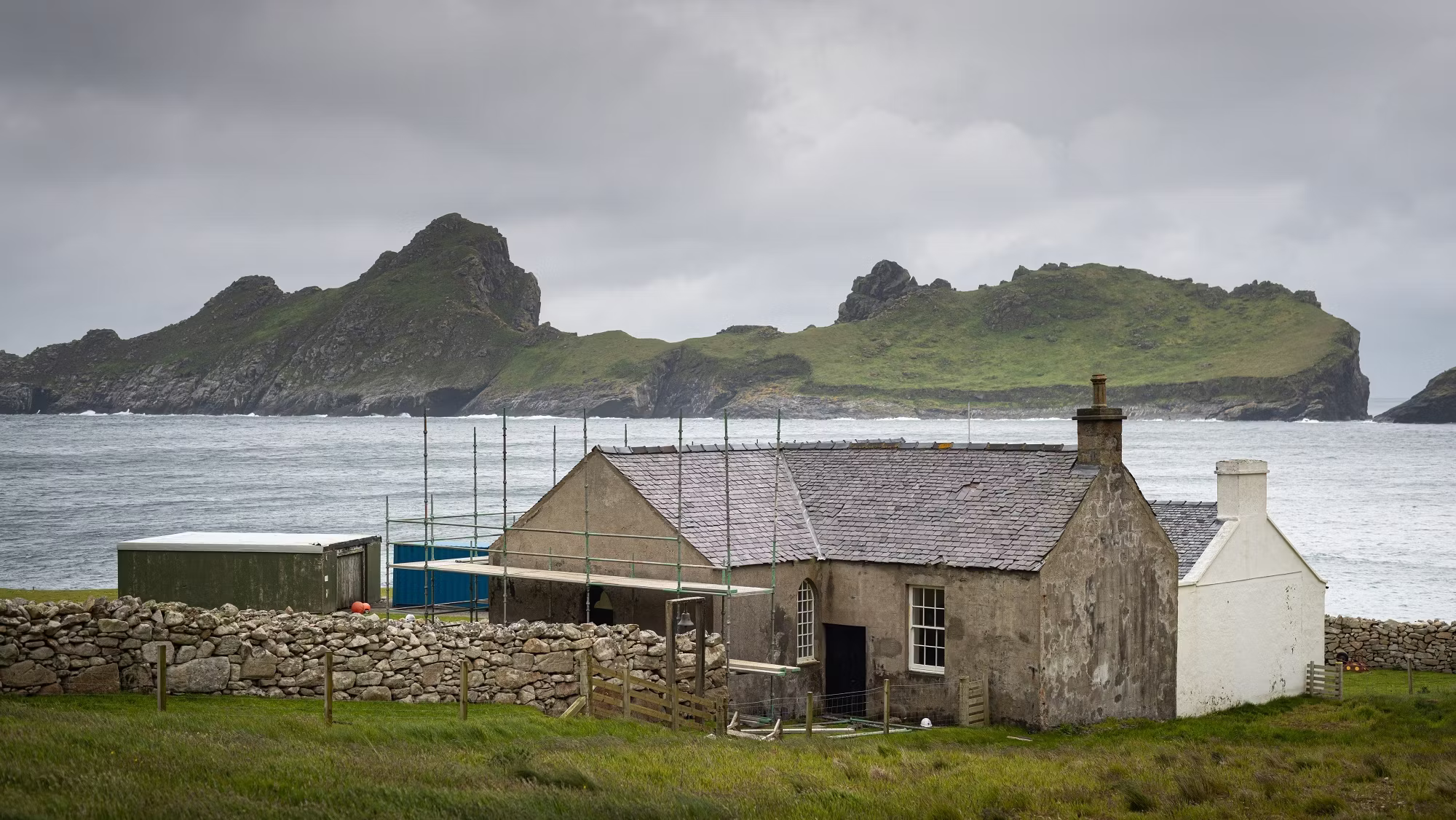
Phase One of St Kilda Kirk Repairs Complete
The subject of our 2023 Annual Appeal, Phase One of the Trust’s project to make the St Kilda Kirk wind and watertight has been completed, and the team is now progressing to Phase Two, which will see the church become fully reinvigorated with restored interiors and a new interpretation plan. This work will finish in the run up to the 100-year anniversary of the island’s evacuation in 2030 and the National Trust for Scotland’s centennial in 2031.
Situated 400 miles off the coast of North Uist, the archipelago of St KiIda is the UK’s only dual UNESCO World Heritage Site – one of just 39 in the world – and is recognized internationally for both its natural and cultural heritage. The last of the islanders left in 1930, and today the abandoned village Kirk and School pay testament to a once thriving community.

Designed by Robert Stevenson, the eminent engineer to the Northern Lighthouse Board (and grandfather of author Robert Louis Stevenson), the Kirk was constructed in 1827-28 after visiting minister Rev Dr John Macdonald commented that the islanders were “ignorant of the leading truths” of Christianity. Ministers and missionaries had visited St Kilda since the 18th century, but the first resident minister was the Reverand Neil Mackenzie, who lived there with his wife and family from 1830-44. The School was added in 1898 to provide a formal learning space.
Today, the Kirk is a key focal point on St Kilda, offering an evocative window into the island’s social and cultural history in the 1800s and early 1900s. It is an integral part of the archaeology of St KiIda and remains an important place of reflection for the islands’ visitors and the people who work there.
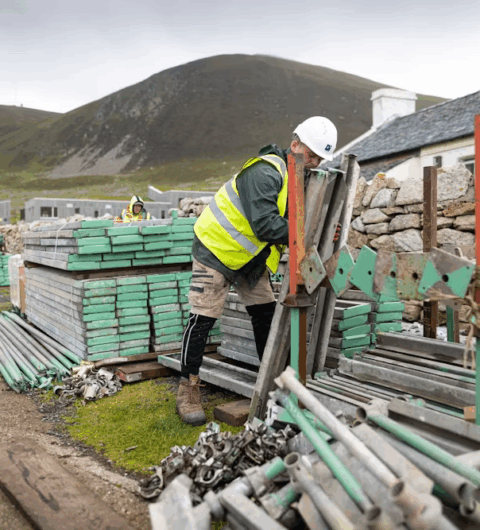
Between June and September 2025, LTM Masonry undertook work to secure the building fabric of the Kirk and the School against weather ingress following considerable deterioration of its external envelope. Work began with an investigation of the existing roof structure, overhaul of deteriorated roof coverings, and reinstallation of gutters and downpipes.
The roof of the Kirk has now been fully restored, and the building’s exterior is secure.
The roof was reslated using a mix of reclaimed Scottish blue-grey slate and new Burlington Blue slates. The work was done using traditional methods, with care taken to match the original style. Salvaged ridge tiles were also reinstalled, and new leadwork was added around the valleys and chimney to protect the structure from water damage.
The project faced some delays due to poor weather and limited transportation to and from the island. Because of this, extra trips were needed over Summer 2025 to finish the roofing, repair the Kirk doors, and install a new drainage system. All Phase One work was completed in September, with the generous support of NTSUSA Annual Appeal donors.
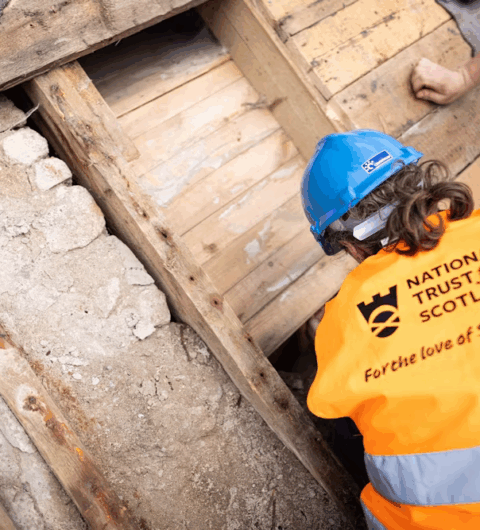
Phase Two has become more pressing as water ingress prior to the roof repair has caused damage to the internal fabric of the building. In particular, the metal nails fixing lining boards to the frame and wall have corroded. This has resulted in the timber framing on the gable end becoming detached in places and visibly moving when touched. The casing above the main door has failed, with a build-up of loose mortar and corroded fixings causing the timber to collapse onto the threshold. Rust spots from the metal fixings are visible on the timber linings throughout, and the updated condition survey has confirmed deterioration. As a result, in 2025 the Trust prevented public entry through the Kirk door and restricted access to a large part of the main body of the Kirk. Without significant repairs to the interior, it is likely access would be further restricted.
Phase Two of the project will begin in Spring 2026 and will include:
- Repairs to historic sash and case windows
- Replacement of post-1930 arched fixed-pane windows with new windows based on historic image evidence, with associated frame lime pointing and internal lining works.
- Targeted repairs to exterior doors and frames
- External joinery redecorations
- Reinstating blocked solum ventilation
- Removal of internal timber wall linings affected by masonry dampness and lime mortar debris build up. Evidenced original linings retained and reinstated, supplemented with matched reproduced linings as required. Incorporation of discrete damp proof protection and cavity ventilation detailing to improve air flow. Framing repairs, internal exposed masonry repointing and consolidation in lime mortar.
- Repairs to decayed timber joist ends, dwarf wall plates, and associated flooring at north end of east wall and north gable, and additional solum ventilation.
- Installation of electrical services facilitating environmental monitoring and conservation fabric heating and dehumidification, as well as lighting to aid public safety
If you would like to learn how you can continue to support work on St Kilda, please contact [email protected].
Greenbank Garden
Moving from the islands to the city, Greenbank Garden is an oasis of tranquility and beauty nestled in Glasgow’s Southside. Greenbank House and its walled garden were created for tobacco merchant Robert Allason in the 1760s, and both are surrounded by tall, swaying beech trees. After the Revolutionary War, Allason went bankrupt and lost the house and estate.
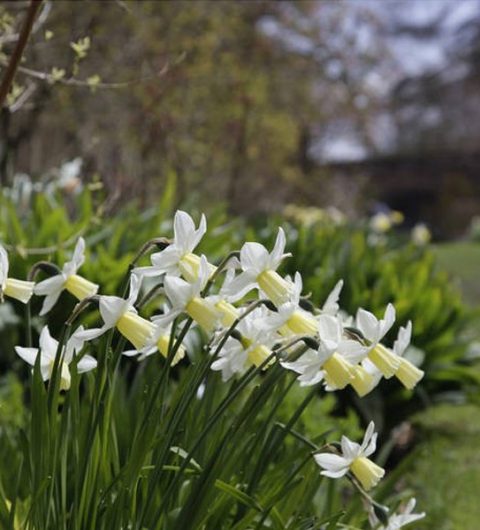
Today, Greenbank Garden is a celebration of West Coast domestic gardening, showcasing over 3,600 named plant species. From its renowned daffodil collection to the winding woodland trails, every corner of Greenbank offers something special to discover. The garden comes alive throughout the year with a vibrant program of public events, welcoming visitors of all ages to share in its charm and creativity. This activity is underwritten, in part, by an endowment bequest from NTSUSA donor John A. McCracken.
Autumn 2024 marked a milestone at Greenbank as the Trust began the restoration of the property’s iconic daffodil collection – one of the largest and most cherished in Scotland. This remarkable collection features over 500 varieties of daffodil, from the beloved Narcissus ‘King Alfred’ to the rare and historic ‘Telamonius Plenus’. The collection has naturally diminished over time, through age and the unavoidable impact of visitors to the garden.
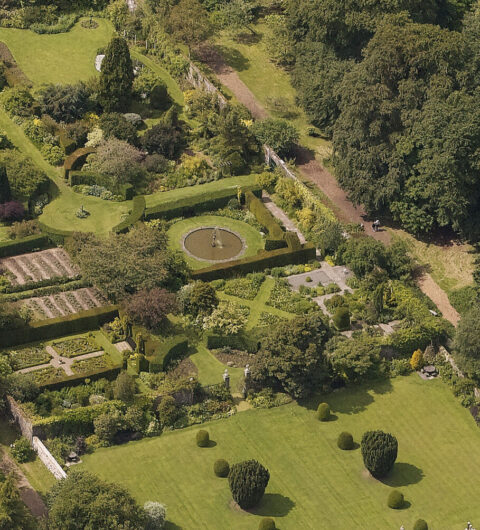
Greenbank Garden
Phase One of the restoration involved planting an incredible 18,000 bulbs between the East Lodge and the corner of Cherry Avenue. A highlight of the season was a community planting day, where volunteers came together to turn donations into a living legacy that will bloom for generations. Phase Two will begin soon, and the garden team is preparing to plant another 50,000 bulbs with the help of local volunteers, ensuring that Greenbank’s daffodils continue to delight and inspire all who visit.
2025 began with an unexpected challenge at Greenbank, as Storm Eowyn swept across Scotland, causing widespread damage to woodlands on Trust properties on the West Coast. At Greenbank, the storm felled a towering fir tree, which brought down three others in its path. The beloved golden Scots Pine in the walled garden was also at risk, leaning precariously after the storm. Thanks to the swift response of Greenbank’s dedicated team and local tree contractors, it was carefully restored and pulled upright – an effort that speaks to the care and commitment behind every corner of the garden.
In the weeks that followed, Trust staff worked tirelessly to clear debris, assess damage, and restore the woodland garden to a safe and welcoming space for visitors. Their efforts ensured that Greenbank’s natural beauty remains accessible and protected.
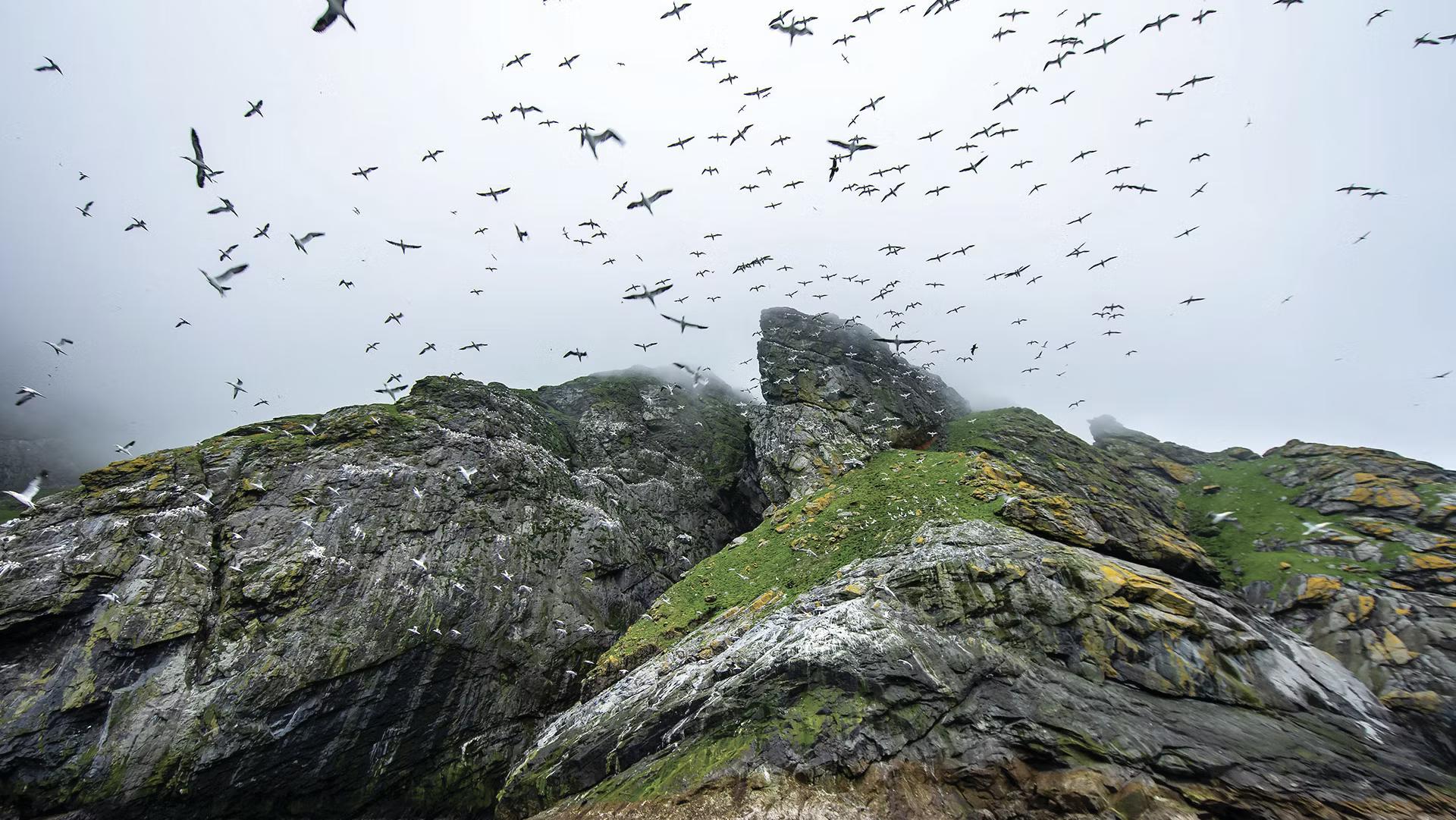
Storm Damage Repair and Tree Planting in the North East
Support from The National Trust for Scotland Foundation USA also enabled the Trust to respond rapidly to storm damage in the North East this year. While the Trust’s goal is to move from a reactive to a proactive approach to landscape management, since August both Storm Floris and Storm Amy affected many regional properties and their impacts needed to be addressed immediately.
In the aftermath of both storms, Trust gardeners, landscape managers, and rangers worked alongside specialist contractors to quickly clear damaged and fallen trees, improve accessibility to woodland trails, and ensure the safety of staff and visitors. As the work at various sites progressed, a program of replanting took place to aid the recovery of these woodlands and replenish their ecosystems, which are home to a variety of flora and fauna.
Measuring the areas affected by the storms is an obstacle due to the sheer vastness of the properties and countryside places in the Trust’s care. Walking surveys were carried out to pinpoint areas of severe damage; this was enhanced by using drones to survey larger areas to distinguish pockets of woodland that bore the brunt of the harsh weather. Working in close partnership with both Scottish Forestry and Forestry and Land Scotland, the Trust secured necessary permissions for felling and clearing work to take place. Woodland management across Scotland is closely monitored and regulated by these agencies.
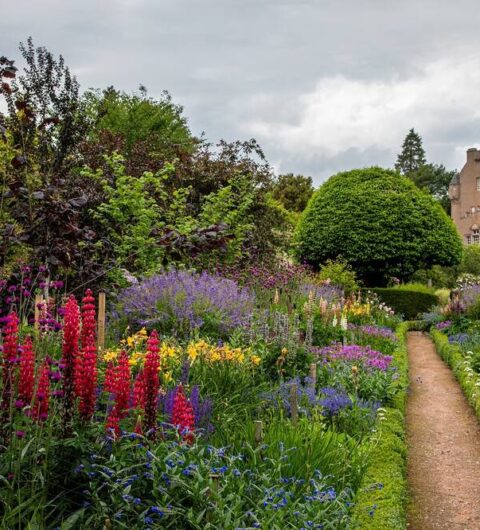
Crathes Castle. Image credit: National Trust for Scotland.
The Trust takes a coordinated and sensitive approach to wildlife management, as its woodlands are home to many species including badgers, herons, squirrels, and bats. The Trust’s team of rangers surveyed wildlife in the affected properties to identify nesting sites and areas to avoid. To ensure the safety of the wildlife, the staff set up protected zones to avoid further disturbance of natural habitats before work got underway.
In addition to coordinating damage response following Storms Floris and Amy, the Trust also is proactively planting new trees across the North East region. At Castle Fraser, the team has built bespoke tree shelters to protect 56 landscape trees within the farmland fields. The Trust is in the process of creating a new wildlife corridor of hawthorn trees that will join up existing landscapes. At Crathes, the Trust is undertaking its largest landscape scale planting, with around 15,000 Scots Pine scheduled to be planted.
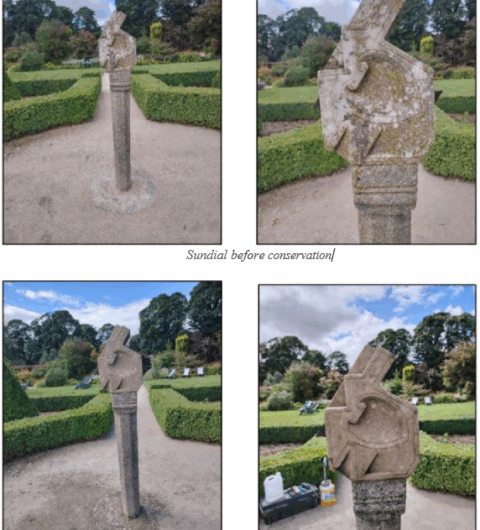
Statuary Conservation in the North East Region
A grant from the Manitou Fund allowed the National Trust for Scotland to conserve statues across many Aberdeenshire castles and gardens this year. Sculpture conservator Graciela Ainsworth embarked on a program of work that has restored significant garden pieces including the Limestone Vessel at Crathes Castle, which had suffered from serious cracking.
At Castle Fraser, the focus has been on the historic sundial. The conservation team carefully cleaned the sandstone surface, gently removing layers of organic growth that had built up over time. Using soft brushes and wooden tools, conservators made sure the cleaning process protected the stone while restoring its appearance. They also treated small cracks in the stone with a specialist conservation mixture to help prevent further deterioration.
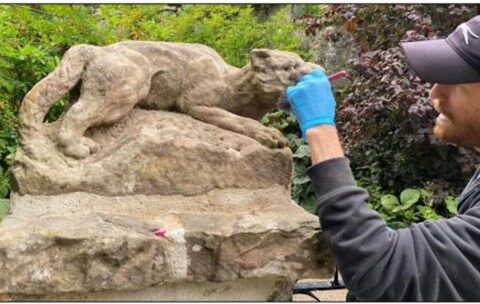
At Leith Hall, conservators focused on the decorative finials found throughout the landscape. During research into these stone ornaments, they made an exciting discovery: one finial we had always believed to be a serpent is actually a dachshund – specifically William, one of the Leith-Hay family’s beloved dogs!
As part of the conservation work, two of the cougar-shaped finials were carefully cleaned. A specialist D/2 biocide solution was applied to treat biological growth, and then thicker lichens were gently removed using wooden tools to avoid damaging the stone.
Canna House Reopens
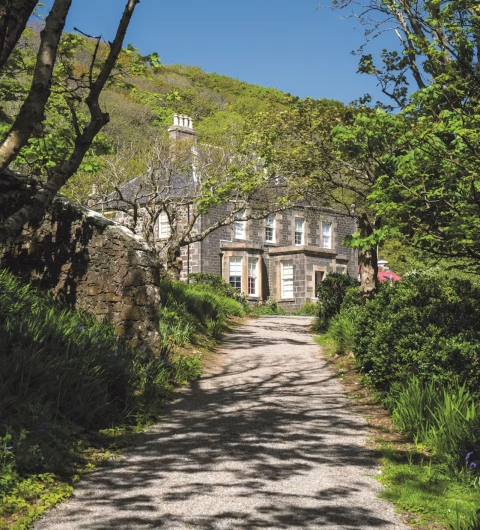
After nine years of careful conservation, and with the support of many NTSUSA members, Canna House reopened its doors to visitors in June 2025. The home of two groundbreaking Gaelic scholars, John Lorne Campbell and his American wife Margaret Fay Shaw, now stands beautifully preserved and ready to share its stories with a new generation.
Extensive repairs to the stonework, roof, and windows of Canna House were necessary to protect it and its contents, including an internationally significant archive collection of Gaelic music, folklore, and culture, from the Hebridean weather.
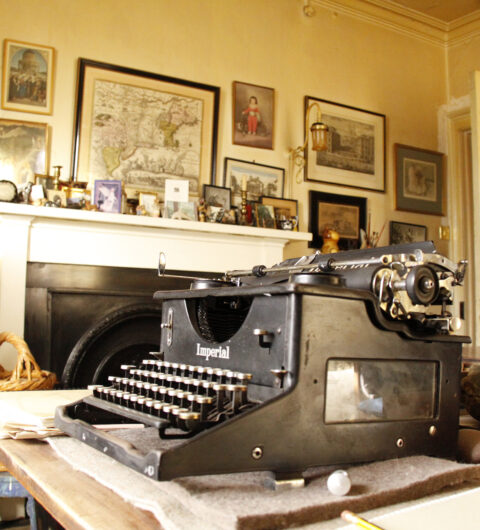
Curators have created an atmosphere that gives visitors a sense that “someone has just left the room,” with a warm, lived-in feel throughout this family home. Gaelic song and language fill the air as audio devices are triggered when visitors move through each room. The Campbells’ extensive collection of personal items acquired over a lifetime are displayed in an organic and eclectic way, showcasing how the house would have looked in the mid-20th century, not long after World War II.
A series of emergency repairs to Canna House began in 2016, but it was in 2022 that the project really gathered pace. Conservation work on an island was incredibly complex and involved the installation of temporary housing pods for contractors.
Over the course of the project, and with your support:
- More than 1,650 objects, 160 pieces of furniture, and 140 framed artworks were cleaned and conserved
- More than 50 history fixtures and fittings were cleaned
- Historic wallpapers and original painted surfaces were cleaned in ten rooms, with other lost original wallpapers recreated.
- Extensive external fabric was conserved and repaired, focusing on future climate resilience
- Canna House underwent structural repairs, and further structural enhancements were made to accommodate new archive facilities
- Improved insulation was introduced to ensure better energy efficiency, and a conservation heating system to protect collections
- Two dedicated archive storage rooms and a reading room for scholars were created within the house. One is dedicated to late NTSUSA Trustee Jeannie Campbell Becton, who left a bequest for the property in her will
Canna House’s reopening is part of a wider celebration of life and nature on the island. In 2025, the property participated in the Trust’s Easter Egg Trails for the first time, and pioneering seabird conservation work is underway. The Trust is proud to support the community’s visitor hub and collaborate on future plans that will continue to enrich Canna’s story.
Conservation Grazing
NTSUSA donors have supported the purchase of animals for four conservation grazing herds based at Culloden, Torridon, Glencoe, and Balmacara by bidding on the right to “name” these coos and goats at our Annual Gala. Conservation grazing is a key component of land management across these sites. When livestock are allowed to graze freely, they select different plants to nibble or browse. Over time, this selective eating creates a varied structure within the plants and the habitat, producing the right conditions for a wide range of insects, birds, reptiles, mammals, and plants to flourish. In addition to their important role in promoting biodiversity, the cows are also a key visitor attraction in their own right, drawing visitors to properties both locally and from further afield.
Primrose
Torridon
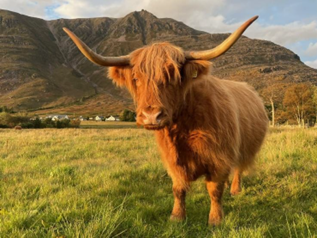
The cows at Torridon have had an enjoyable summer wandering between their three fields, trampling the rushes and eating the grass down. The herd includes Twix, Primrose, Maggie, and Jura. New fencing has been installed to separate the species-rich grassland areas from the improved grassland. The cows have been moved on to the species-rich areas now that wildflowers have seeded, and they will graze down the grass to prevent it dominating and ensure a fine display of wildflowers next year. After a few years of absence, Lesser Butterfly Orchids returned to the fields this year, which can be attributed to having re-introduced grazing to the fields.
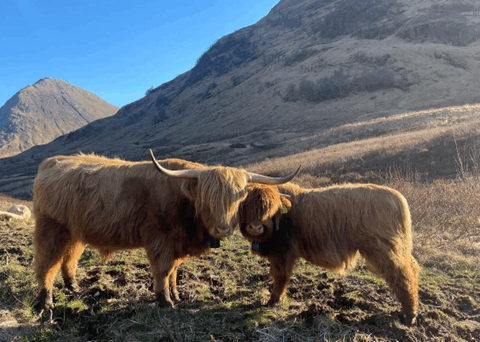
Spencer and Ossian
Glencoe
The newest addition to the herd at Glencoe is Oisean (pronounced Aw-shin or Aw-shan). Oisean, a young bullock, came from Highland Fold, a herd of Highland Cattle kept on a beautiful hill farm near Barcaldine in North Lorn, Argyll, 25 miles south of Glencoe. (Highland Cattle are most often raised as beef cattle, but Highland Fold are predominantly dairy cows – the cows provide milk rich in butterfat (8-10%!) which is turned into delicious Highland Fold ice-cream!
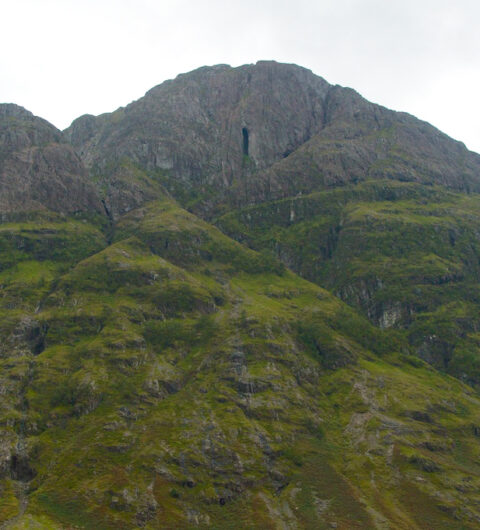
Ossian's Cave, Glencoe
Oisean’s name is closely tied to the legends surrounding Ossian’s Cave, a natural formation in the craggy face of Aonach Dubh. Geologically, the cave was formed when magma intruded into the mountain’s rock and later cooled and contracted, causing a column of rock to break away. According to Gaelic folklore, this cave is said to be the birthplace of Oisean (the Scottish Gaelic spelling of Ossian), the son of the great warrior Fionn MacCumhaill and Sadhbh – a woman who had been transformed into a deer.
Different versions of the legend explain Sadhbh’s transformation: some say a wizard cursed her after she rejected him, while others claim it was a jealous fairy-lover (one of the Daoine Shhe) who turned her into a deer upon learning of her love for Fionn. The name Oisean – meaning “little deer” or “fawn” – reflects this part of his origin story.
After Oisean had settled in, the Trust’s tenant farmer made the decision to move Moko on from Glencoe. At the grand age of 14, Moko was showing signs that she was beginning to struggle with Glencoe’s rough, wet terrain. She has now moved to a farm in the Scottish Borders where she will be much more comfortable grazing their green & grassy rolling hills.
Spencer and Oisean are proving very popular with visitors to the area – Spencer may well be the most photogenic and most photographed Highland cow in Scotland! But though we are pleased to see that the cattle are so popular with visitors, the reason that they are here is to graze the hillside of MealI Mor where rare wildflowers and mushrooms need a certain degree of grazing to come through. The two boys have been fitted with nofence collars which, after a trial period, will be used to encourage them to graze specific parts of the hill.
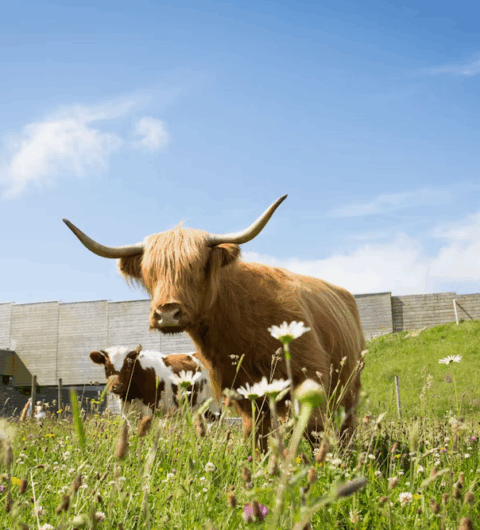
Photo: Alison White
Culloden
The herd at Culloden includes Alexander Hamilton, Eilidh, Flora, Isla, Loki, Xena, Mhari, AiIsa and Ali. Loki is the youngest of the herd and is very playful, answering to his name. Eilidh is known for her happy-go-lucky nature and tends to go along with the herd.
Caring for the landscape at Culloden is a delicate process. The field is a war grave, so the work of restoring the sacred ground is extremely sensitive. Using heavy machinery might result in the upset of resting place of hundreds of soldiers. Highland and Shetland cattle, on the other hand, are small and agile and can consume 155 pounds of plant matter a day. They eat everything from the fast-growing birch to prickly gorse. the herd is positioned in different sections of the park, allowing the desolate upland moor to resuscitate.
Balmacara
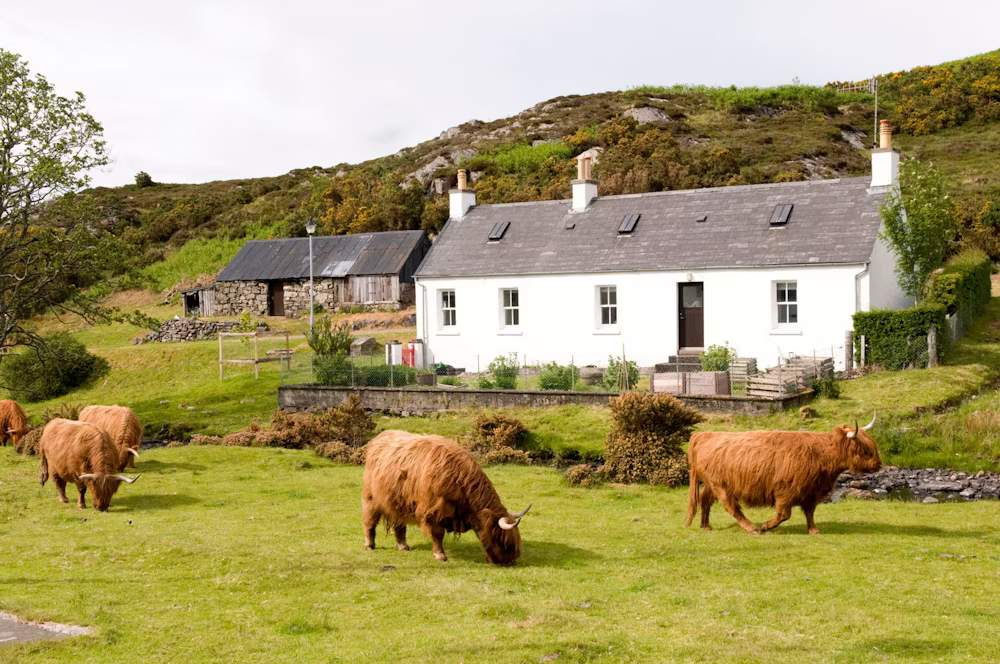
There are six cows currently staying at Balmacara Estate: Gwendolyn, Moon, Delfinia, Anne, Emily and Charlotte.
Balmacara is a diverse Highland crofting estate. The mosaic of arable croft fields around small settlements, with outlying moorland and common grazing, reflects a historically important land use of the West Highlands that still remains relevant to local communities today.
The estate’s rocky, moorland-covered hills are interspersed with lochs, woodlands and crofting settlements, with a long and intricate coastline scattered with offshore islands. This diversity means the estate supports a wide variety of wildlife and plants native to the Scottish Highlands, including the ancient oak woodland of the Coille Mhor – part of Scotland’s temperate rainforest. The cows help preserve the biodiversity of these important habitats, and the team uses no-fence collars to track their movements around the reserve.